
1-Channel Relay Module - 12V (High and Low Level Trigger)
1-Channel Relay Module - 12V (High and Low Level Trigger) Original price was: 145৳ .Current price is: 130৳ .
Back to products
12V 4 Channel Relay Module
12V 4 Channel Relay Module Original price was: 339৳ .Current price is: 290৳ .

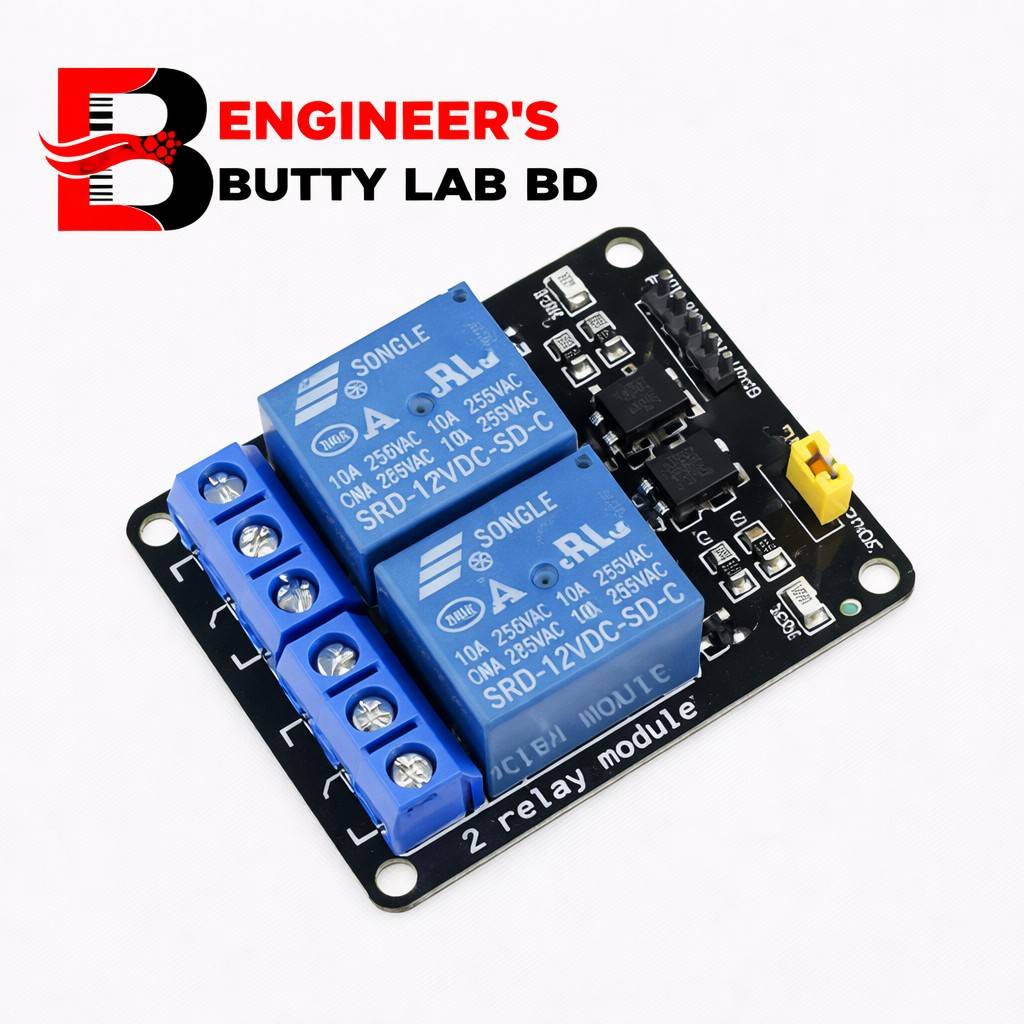
12V Dual Channel Relay Module

SKU: EBL-1090

Specifications:

  • Dual channel (2 relay) module with 10A load capacity per relay
  • Compatible with Arduino, Raspberry Pi, ESP32, and PIC
  • Optocoupler isolation for high voltage protection
  • Input trigger voltage: 3.3V–5V compatible with logic signals
  • Supports both AC (250V) and DC (30V) loads
  • LED indicators for power and relay status

Original price was: 245৳ .Current price is: 195৳ .

11 in stock

Ordered:0
Items available:11

11 in stock

10 People watching this product now!

Payment Methods:

Description

🔌 12V Dual Channel Relay Module

2 Channel | 10A High Power Switching | Industrial Automation Compatible


📌 Overview

The 12V Dual Channel Relay Module is a high-power switching module designed to control two independent AC or DC loads using a 12V control signal.

It is commonly used in:

  • Industrial automation

  • Motor control systems

  • Smart home automation

  • Power switching applications

  • Robotics and embedded systems

Each channel contains a 12V electromagnetic relay capable of switching high-voltage loads safely.


⚡ Relay Specifications

Feature Specification
Relay Type Electromagnetic
Coil Voltage 12V DC
Channels 2
Contact Rating 10A 250VAC
Contact Rating 10A 30VDC
Relay Model SRD-12VDC-SD-C (common)

🔌 Input Pin Configuration

Pin Function
VCC 12V Power Supply
GND Ground
IN1 Channel 1 Control
IN2 Channel 2 Control

Some versions include:

  • High/Low trigger selection jumper


🔄 Trigger Modes

Depending on board version:

  • 🔹 Low Level Trigger → Relay activates when input is LOW

  • 🔹 High Level Trigger → Relay activates when input is HIGH

Trigger type may be fixed or selectable via jumper.


🔌 Output Terminals (Per Channel)

Each relay has three screw terminals:

Terminal Function
COM Common
NO Normally Open
NC Normally Closed

Operation:

Relay OFF:

  • COM connected to NC

Relay ON:

  • COM connected to NO


🧠 Working Principle

  1. Control signal applied to IN1 or IN2.

  2. Transistor driver energizes 12V relay coil.

  3. Magnetic contact switches.

  4. High-voltage device turns ON or OFF.

Provides electrical isolation between control circuit and load circuit.


💡 Onboard Features

✔ 2 × 12V relays
✔ Transistor driver circuits
✔ Flyback diode protection
✔ Status LEDs for each channel
✔ Power LED indicator
✔ Screw terminal blocks
✔ Mounting holes


📐 Electrical Specifications

Parameter Value
Supply Voltage 12V DC
Control Current ~20–30mA per channel
Max Switching Current 10A
Isolation Mechanical isolation

📏 Physical Specifications

  • PCB Color: Black / Blue

  • Durable industrial-grade PCB

  • Mounting holes for secure installation

  • Standard 2.54mm header pins


🎯 Advantages

✔ Control two devices independently
✔ Suitable for industrial systems
✔ High voltage & current capability
✔ Reliable and durable
✔ Easy to integrate
✔ Strong isolation for safety


📦 Applications

  • Industrial control panels

  • Motor switching systems

  • Smart irrigation systems

  • Lighting automation

  • Pump control

  • HVAC control

  • Robotics switching systems

  • IoT power control


🆚 5V vs 12V Relay Module

Feature 5V Relay 12V Relay
Coil Voltage 5V 12V
Suitable For Arduino projects Industrial systems
Stability Good Better for heavy systems
Power Source 5V supply 12V supply

🧑‍💻 Basic Example (12V System)

int relay1 = 7;
int relay2 = 8;

void setup() {
pinMode(relay1, OUTPUT);
pinMode(relay2, OUTPUT);
}

void loop() {
digitalWrite(relay1, HIGH);
digitalWrite(relay2, HIGH);
delay(2000);

digitalWrite(relay1, LOW);
digitalWrite(relay2, LOW);
delay(2000);
}

Customer Reviews

0 reviews
0
0
0
0
0

There are no reviews yet.

Be the first to review “12V Dual Channel Relay Module”

Your email address will not be published. Required fields are marked *

1 2 3 4 5
1 2 3 4 5
1 2 3 4 5