


Design of a Mini Refrigerator System

SKU: EP-5010

Services:

Complete Project + Thesis Book (Soft Copy) + Presentation Slide (Soft Copy)

Detailed Video: https://youtu.be/eOf9s1MwdiQ


জবের পাশাপাশি B.Sc. or M.Sc. in Engineering Study করছেন? গ্রুপের সবাই Final Year প্রজেক্টের জন্য সম্মিলিত ভাবে সময় বের করতে পারছেন নাহ? “কম খরচে” এবং “কম সময়ে” আপনার প্রয়োজনীয় প্রজেক্ট টি পেতে চান? আপনাদের জন্যই কাজ করছে “#Engineers_Butty_Lab_BD” আপনার প্রয়োজনীয় প্রজেক্ট, থিসিস বুক , প্রেজেন্টেশন স্লাইড পেতে যোগাযোগ করুন।

আমরা কি ধরনের প্রজেক্ট করি?

Mechanical Project, Raspberry Pi Project, Arduino Based Project, ESP8266 based Project, GSM Based Project, Robotic Project, Solar Based Project, IoT based Project, Drone Project.

মোটকথা আপনার যা প্রয়োজন পেয়ে যাবেন আমাদের থেকে। বি.দ্র: (বিকাশ-নগদ-রকেট) এর মাধ্যমে ৭৫% এডভান্স পেমেন্ট করলে বাংলাদেশের যে কোনো জেলায় হোম ডেলিভারি পেয়ে যাবেন!

14,000৳ 

15 People watching this product now!

Payment Methods:

Description

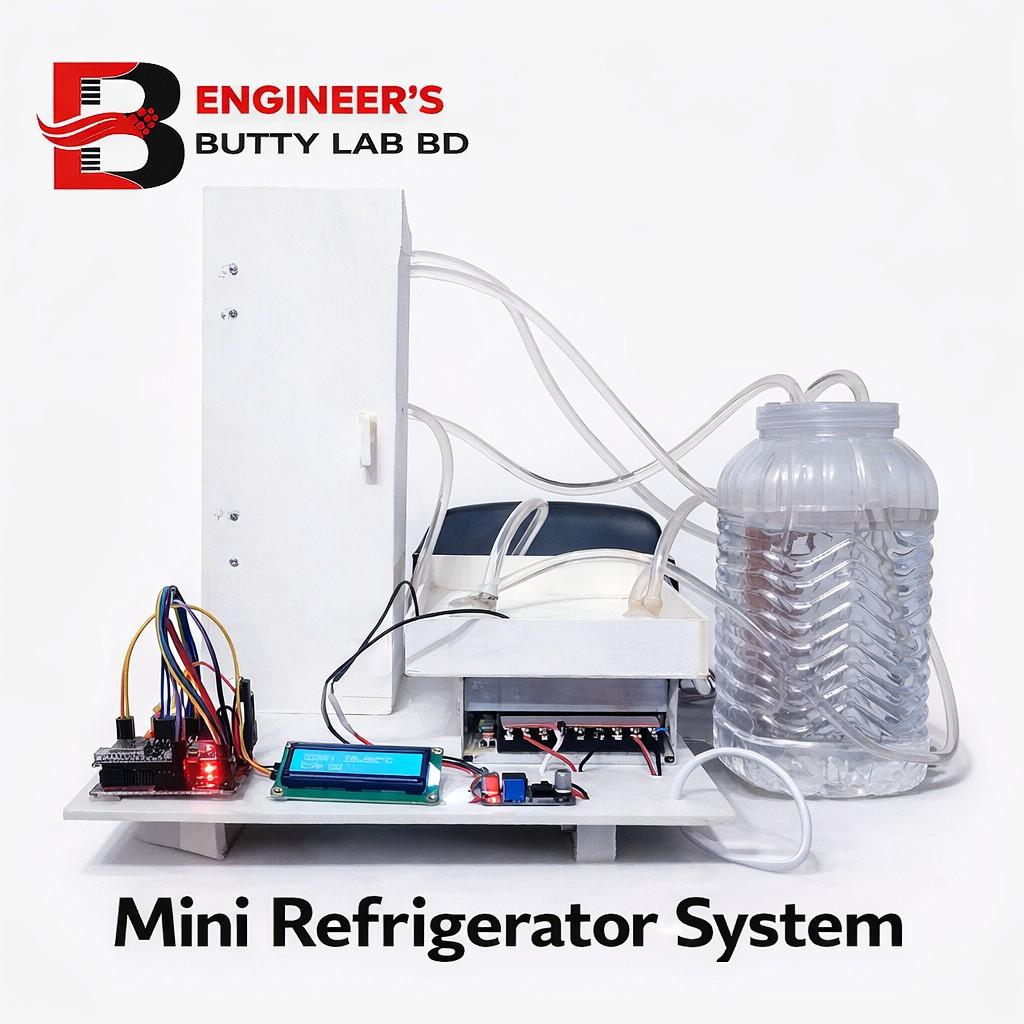
Design of a Mini Refrigerator System

Project Overview

The Mini Refrigerator System is a compact, low-power cooling solution designed using basic electronic components and thermoelectric cooling technology. This project demonstrates how a small-scale refrigerator can be built for educational, laboratory, and prototype applications where conventional refrigerators are impractical due to size, cost, or power consumption. The system is ideal for storing small items such as medicines, beverages, biological samples, or electronic components.


Objective

The main objectives of this project are:

  • To design and develop a portable mini refrigeration system

  • To understand the working principle of thermoelectric cooling (Peltier effect)

  • To monitor and control temperature using a microcontroller-based system

  • To build an energy-efficient and cost-effective cooling solution


System Description

The mini refrigerator system uses a Peltier module as the cooling element. When electric current passes through the Peltier device, one side becomes cold while the opposite side becomes hot. The cold side is placed inside the refrigerator chamber, and the hot side is connected to a heat sink and cooling fan to dissipate excess heat.

An Arduino (or similar microcontroller) is used to control the cooling operation and monitor temperature data through a temperature sensor. The system displays real-time temperature values on an LCD display and can automatically switch the cooling mechanism ON or OFF based on predefined temperature thresholds.


Main Components Used

  • Microcontroller (Arduino Uno / Nano)

  • Peltier (Thermoelectric) Module

  • Heat Sink and Cooling Fan

  • Temperature Sensor (LM35 / DHT11 / DS18B20)

  • LCD Display (16×2)

  • Relay Module or MOSFET

  • DC Power Supply / Adapter

  • Insulated Mini Chamber

  • Connecting Wires and Supporting Circuitry


Working Principle

  1. Power is supplied to the system through a DC source.

  2. The microcontroller continuously reads temperature data from the sensor.

  3. When the temperature inside the chamber rises above a set value, the controller activates the Peltier module.

  4. The cold side of the Peltier cools the chamber, while the hot side is cooled using a heat sink and fan.

  5. Temperature values are displayed on the LCD in real time.

  6. Once the desired temperature is reached, the controller turns OFF the cooling unit automatically.


Features

  • Compact and portable design

  • Low power consumption

  • Automatic temperature control

  • Real-time temperature display

  • Educational and demonstration-friendly

  • Environment-friendly (no refrigerant gas)


Applications

  • Medical storage for vaccines and medicines

  • Laboratory sample cooling

  • Beverage cooling

  • Electronics component storage

  • Educational and academic projects

  • Portable cooling systems


Advantages

  • Simple and economical design

  • No harmful gases used

  • Low maintenance

  • Lightweight and portable

  • Easy to expand with IoT or automation features


Future Enhancements

  • Integration with IoT platforms for remote temperature monitoring

  • Mobile app-based control

  • Solar-powered operation

  • Improved insulation for better efficiency

  • Digital thermostat control


Conclusion

The Mini Refrigerator System successfully demonstrates a practical implementation of thermoelectric cooling using microcontroller-based automation. It serves as an excellent project for students and researchers to understand refrigeration concepts, embedded systems, and energy-efficient design. With further enhancements, this system can be adapted for real-world applications.

Customer Reviews

0 reviews
0
0
0
0
0

There are no reviews yet.

Be the first to review “Design of a Mini Refrigerator System”

Your email address will not be published. Required fields are marked *

1 2 3 4 5
1 2 3 4 5
1 2 3 4 5